
Why Brilliant VPs Get Passed Over for the C-Suite – And How to Break Through
She stared at the rejection email for the third time. Same organization. Same role. Same “not quite ready” feedback.
She’d exceeded every target, led a major division flawlessly, earned an MBA from a top-tier school. Her team respected her. Peers admired her results.
What more did they want?
“I don’t understand,” she told me. “I deliver every single goal they give me. What am I missing?”
I’d seen this story dozens of times. Exceptional VPs and leaders who couldn’t break through to the executive suite. Not because they weren’t talented—but because they were trapped in a pattern they couldn’t see.
Welcome to the VP Leadership Trap.
The Gap Nobody Tells You About
Here’s what they don’t tell you when you become a VP:
The skills that made you a successful VP are the same skills that will keep you from becoming a CEO.
You became a VP because you mastered your function. You’re exceptional at finance, operations, sales, technology, or whatever your domain is. You deliver results. You manage complexity. You build strong teams.
All of that is necessary. None of it is sufficient.
Because the C-suite isn’t about deeper functional expertise. It’s about different thinking entirely.
What I Learned Climbing From Design Engineer to Corporate Officer
My journey took me from the technical trenches to the executive floor. Design engineer to manager to director to VP to Corporate Officer to CEO.
And at every transition, I had to unlearn what made me successful at the previous level.
The transition from VP to C-suite was the hardest.
Not because the work was more difficult—but because the thinking was fundamentally different.
As a VP, my value came from solving problems in my domain. As a Corporate Officer, my value came from seeing patterns across domains that nobody else could see.
As a VP, success meant optimizing my function. As an executive, success meant optimizing the entire enterprise—even when that meant making my function less efficient for the greater good.
As a VP, I thought in terms of my budget, my team, my results. As a C-suite leader, I had to think in terms of the whole system and how every part affected every other part.
That shift—from functional mastery to enterprise thinking—is where most VPs get stuck.
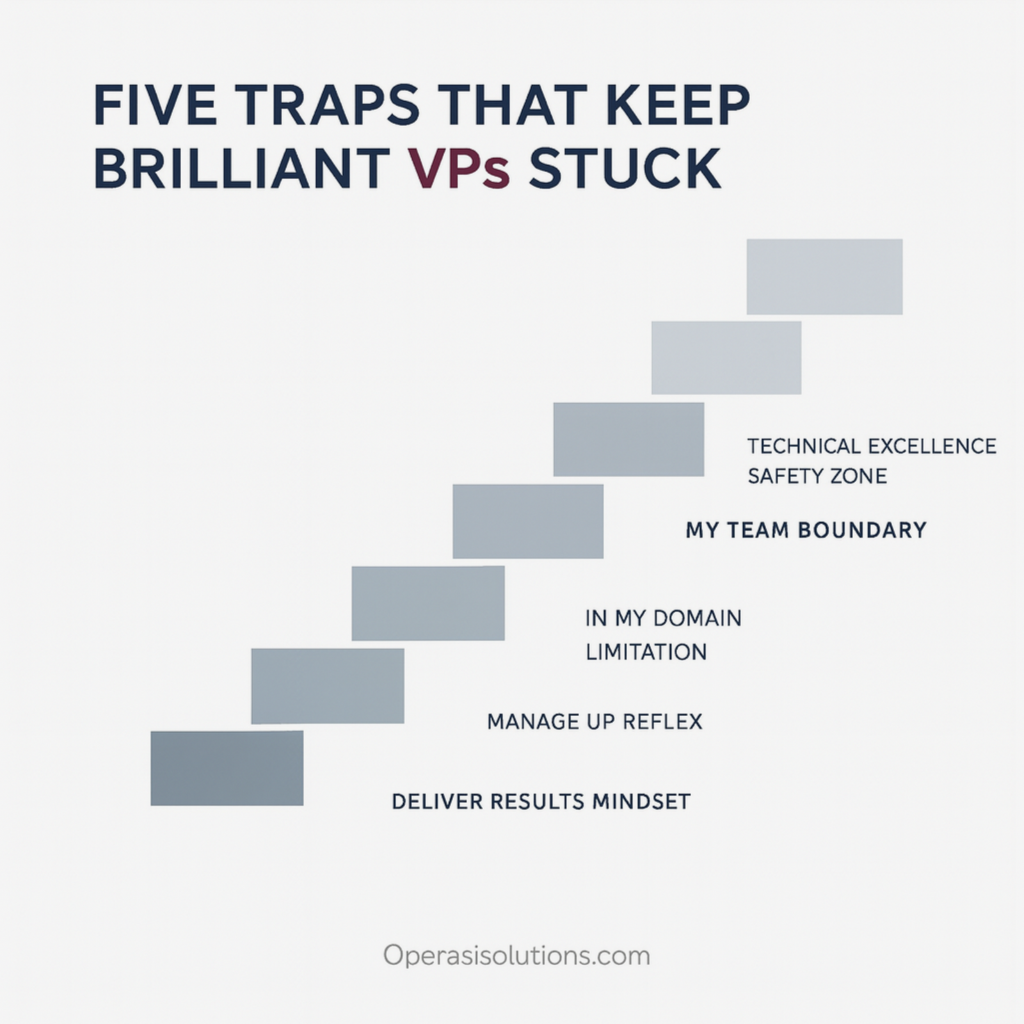
Five Traps That Keep Brilliant VPs Stuck
After living this transition myself and guiding dozens of executives through it, I’ve identified five patterns that keep otherwise exceptional VPs from breaking through:
Trap 1: The “Deliver Results” Mindset
VP thinking: “Give me clear objectives, and I’ll exceed them.”
C-suite thinking: “What objectives should we set that will transform this business three years from now?”
VPs execute strategy brilliantly. C-suite executives question whether it’s the right strategy.
The trap: Boards don’t promote the best executors. They promote the people who can see what needs executing before anyone else does.
Trap 2: The “In My Domain” Limitation
VP thinking: “Let me optimize my function.”
C-suite thinking: “How do our functions work together as a system?”
I’ve watched brilliant operations leaders who couldn’t see beyond manufacturing. Outstanding engineering directors who couldn’t think commercially. Exceptional sales VPs who didn’t understand how to build organizational capability.
The trap: C-suite leadership requires seeing the whole chessboard, not just your pieces.
Trap 3: The “Manage Up” Reflex
VP thinking: “What does the CEO want?”
C-suite thinking: “What does the business need, even if the CEO hasn’t recognized it yet?”
VPs who become C-suite executives learn to challenge their leaders constructively. They bring perspectives, not just execution. They’re trusted advisors, not talented subordinates.
The trap: If you can’t respectfully challenge the people promoting you, you’re not ready to sit beside them.
Trap 4: The “My Team” Boundary
VP thinking: “How do I develop my direct reports?”
C-suite thinking: “How do I develop leaders three levels down who I rarely see?”
When I managed operations across North America with thousands of employees, I couldn’t personally develop everyone. But I could create systems that developed leaders at every level—leaders who would develop others.
The trap: C-suite leadership is about building systems that build leaders, not just building your immediate team.
Trap 5: The “Technical Excellence” Safety Zone
VP thinking: “I’ll be the best at my function.”
C-suite thinking: “I’ll know enough about everything to make enterprise decisions.”
This was my biggest trap. As an engineer, I loved diving deep into technical details. It’s where I felt confident. But C-suite decisions require breadth more than depth.
The trap: You can’t be the expert at everything. You have to be wise about everything.
The Moment Everything Changed
I’ll never forget the conversation that shifted my thinking.
I was a director presenting a major innovation initiative to the executive team. I had every detail perfected. Technology roadmap. Market analysis. Implementation plan.
The CEO stopped me halfway through: “I trust your analysis. What I want to know is: If you were running this business and could only fund three initiatives this year, would this be one of them? And why?”
I froze.
I’d been thinking about my project. He was asking me to think about the enterprise portfolio. To prioritize against opportunities I’d never evaluated. To consider trade-offs I hadn’t thought about.
I was thinking like a director trying to get resources. He needed me to think like an executive allocating them.
That question haunted me for weeks. I’d been so focused on being the best at my function that I’d never thought about the whole enterprise. I’d been optimizing my piece without understanding the puzzle.
That’s when I finally saw the pattern—the same pattern I’d watched trap dozens of brilliant functional leaders.
What Enterprise Thinking Actually Means
Enterprise thinking isn’t a skill you develop. It’s a perspective you adopt.
It means:
Seeing Trade-Offs, Not Just Opportunities: Every investment means not investing somewhere else. Every strategic choice has a cost. When I finally understood this, I stopped asking “why not fund this?” and started asking “what are we choosing not to do?”
Understanding How Parts Affect the Whole: When we optimized one part of operations, it sometimes created problems elsewhere. Enterprise thinking sees these connections and finds systemic solutions. We saved significant resources by redesigning how functions worked together rather than optimizing any single one.
Thinking in Systems, Not Functions: C-suite executives don’t manage functions. They manage the interactions between functions—the gaps, the handoffs, the places where value gets created or destroyed at the boundaries.
Balancing Short-Term and Long-Term: VPs focus on this quarter’s results. C-suite executives think about what capabilities the organization needs three years from now—and start building them today.
Acting Like an Owner: VPs act like talented employees. C-suite executives act like owners who’ll live with the long-term consequences of every decision.
The Questions That Reveal the Gap
Want to know if you’re thinking like a VP or a C-suite executive?
When you present to senior leadership, do you focus on:
• Your function’s results? (VP thinking)
• How your function enables enterprise strategy? (C-suite thinking)
When you make decisions, do you optimize for:
• Your division’s performance? (VP thinking)
• Enterprise value, even when it hurts your numbers? (C-suite thinking)
When you develop your team, do you focus on:
• Making them great at their jobs? (VP thinking)
• Preparing them for the next level, even if it means losing them? (C-suite thinking)
When you think about strategy, do you:
• Execute what you’re given exceptionally well? (VP thinking)
• Question whether it’s the right strategy? (C-suite thinking)
If most of your answers are in the left column, you’re stuck in the VP trap.
Breaking Free
Here’s what I wish someone had told me 15 years earlier:
You won’t get promoted to the C-suite by being better at your current job. You’ll get promoted by demonstrating you can think at the next level.
That means:
- Stop waiting for perfect clarity. C-suite executives operate in ambiguity.
- Start thinking about enterprise portfolio decisions, not just your projects.
- Develop relationships across functions, not just within yours.
- Challenge assumptions respectfully, not just execute brilliantly.
- Think like an owner, not an employee.
The technical skills that got you to VP matter. But they’re table stakes now.
The thinking that will get you to C-suite is entirely different.
Your Next Summit
If you’re a VP or SVP who knows you’re capable of more but can’t figure out why you’re not breaking through, this is your moment.
The gap isn’t your talent. It’s your thinking.
And thinking can be developed—if you’re willing to see it, name it, and do the work.
Because the world doesn’t need more exceptional VPs.
It needs more VPs who are ready to think—and lead—at the enterprise level.
I think about that woman who received her third rejection often. She eventually made it to the C-suite—but only after she stopped trying to be a better VP and started thinking like a CEO.
The breakthrough came when she presented a cost-cutting initiative for her division—and then explained why the company shouldn’t fund it. She’d found a better use of that capital in another division.
That’s enterprise thinking. And that’s what boards promote.
The question isn’t whether you’re good at your job. You’ve proven that.
The question is: Are you ready to think about something bigger than your job?
Raj Gupta
Former Corporate Officer of a Global Enterprise, CEO
If this resonates, let’s talk. The best conversations I have are with leaders who know they’re capable of more—but aren’t sure what “more” really means.